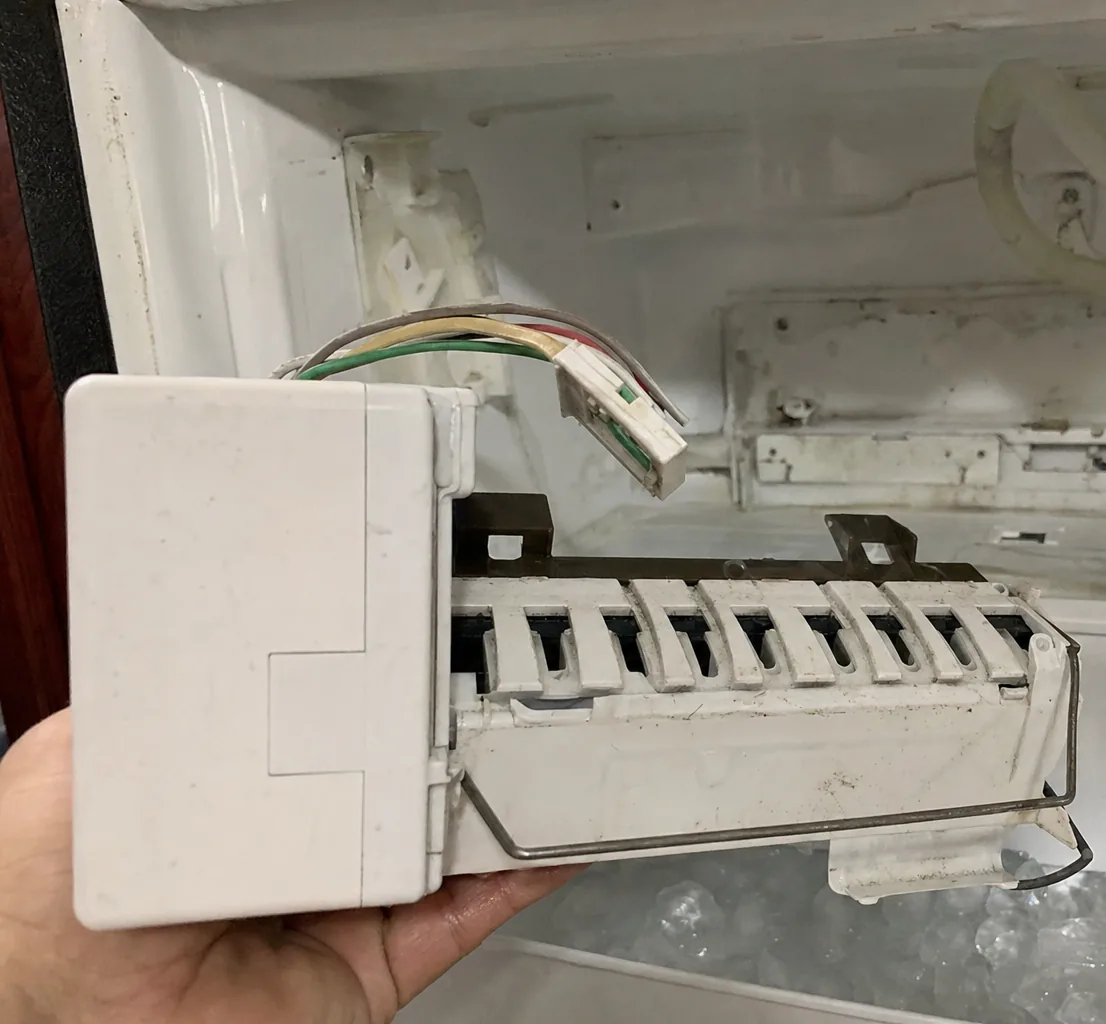
Most of the calls we take begin with ice. The cubes went small, or hollow, or stopped altogether, or the bin has a solid slab in it where loose cubes used to be. And most of those calls are not about the ice maker.
That is not a rhetorical opening. It is a mechanical claim, and it is worth setting out properly, because believing the ice maker is broken is the single most expensive assumption a household can arrive at before we get there.
The mechanism
An ice maker will not begin a harvest until the mold reaches its release temperature. It is a thermostatically triggered device sitting inside a compartment, entirely dependent on that compartment doing its job.
That makes it the most temperature-sensitive process the cabinet performs. Frozen food does not care about two degrees; it stays frozen and looks fine. The panel, reading its own sensor, often still shows a plausible number. But a compartment running a few degrees warmer than it should will fill a mold, freeze it slowly, and never release it — which presents on the phone as “the ice maker has failed”.
On a built-in running two independent sealed systems, this gets more confusing still. The fresh-food side can be performing perfectly while the freezer side struggles, so the household reports that the refrigerator is fine and only the ice is wrong. Frequently the opposite is true.
What is actually upstream of the ice
Four things, in roughly this order of frequency.
Condenser fouling. Pet hair and household dust build a mat across the condenser until it cannot reject heat properly. Run times lengthen, head pressure rises, and the compartment drifts. It is a slow failure, which is why people describe it as “it has been a little warm for a while” rather than as a breakdown.
Defrost and drain failures. Water that should leave the cabinet does not, and refreezes where it sits. The classic sign is a slab in the bin rather than loose cubes, and the slab is evidence that the bin is warming between harvests — the ice maker is doing exactly what it was told to do.
Control faults after a storm outage. The surge and voltage instability when supply is restored damages boards partially far more often than it kills them outright. One of the first things a half-working control does is stop commanding a harvest reliably, and because the damage is thermal it often surfaces weeks after the storm.
Door gaskets. A seal that is ninety per cent effective admits humid air all day, the defrost system runs more often to cope, the bin warms more often, and the cubes fuse. Cheapest fault on the machine, and the one that makes the other three worse.
Why the wrong story is expensive
If you go in believing the ice maker is the fault, there is a predictable sequence. You buy an ice maker. The ice improves briefly — because the unit was disturbed and the bin was emptied — and then it does not. You are quoted for a fill valve. Six weeks later the slab is back, because the drain was blocked the entire time and nobody looked at it.
That is two parts and three visits to solve a problem that was never in the ice maker.
What to do with this
Two things. First, when you describe the fault to anyone, describe what the cabinet is doing rather than what you think the cause is: which compartment is warm, what a thermometer sitting on a shelf says versus what the panel says, whether the bin holds loose cubes or a slab, whether the cubes are hollow or merely small, and whether anything happened during a storm that week. That is the information that actually narrows it.
Second, if someone proposes a new ice maker without having measured the freezer compartment or looked at your condenser, ask them what the compartment was holding when they checked. If the answer is that they read it off the display, they have not checked.